South of Brive
Km 8-14: Walnut country and the walls of Turenne
Standings
See full standings ↓Elevation Profile
Scroll to zoom, drag to pan. Double-click to reset.
Power Stats
Reference: 70kg rider + 8kg bike, CdA 0.35, Crr 0.005
Estimated Time
South of Brive
The peloton leaves Brive at speed. Within minutes, the retail parks and roundabouts give way to open farmland, and the road tilts gently downhill. This is the Bassin de Brive - one of the warmest, most fertile lowlands in the Limousin - and in early April it is just waking up. The walnut trees that line the fields are beginning to leaf out, their branches still skeletal against the pale sky.
Six kilometers of descent. A net drop of 141 meters. The steepest pitch hits -6.5%, where the peloton would touch 75 km/h on the open road. The whole segment passes in under six minutes at racing speed. The riders barely pedal.
The Walnut Country
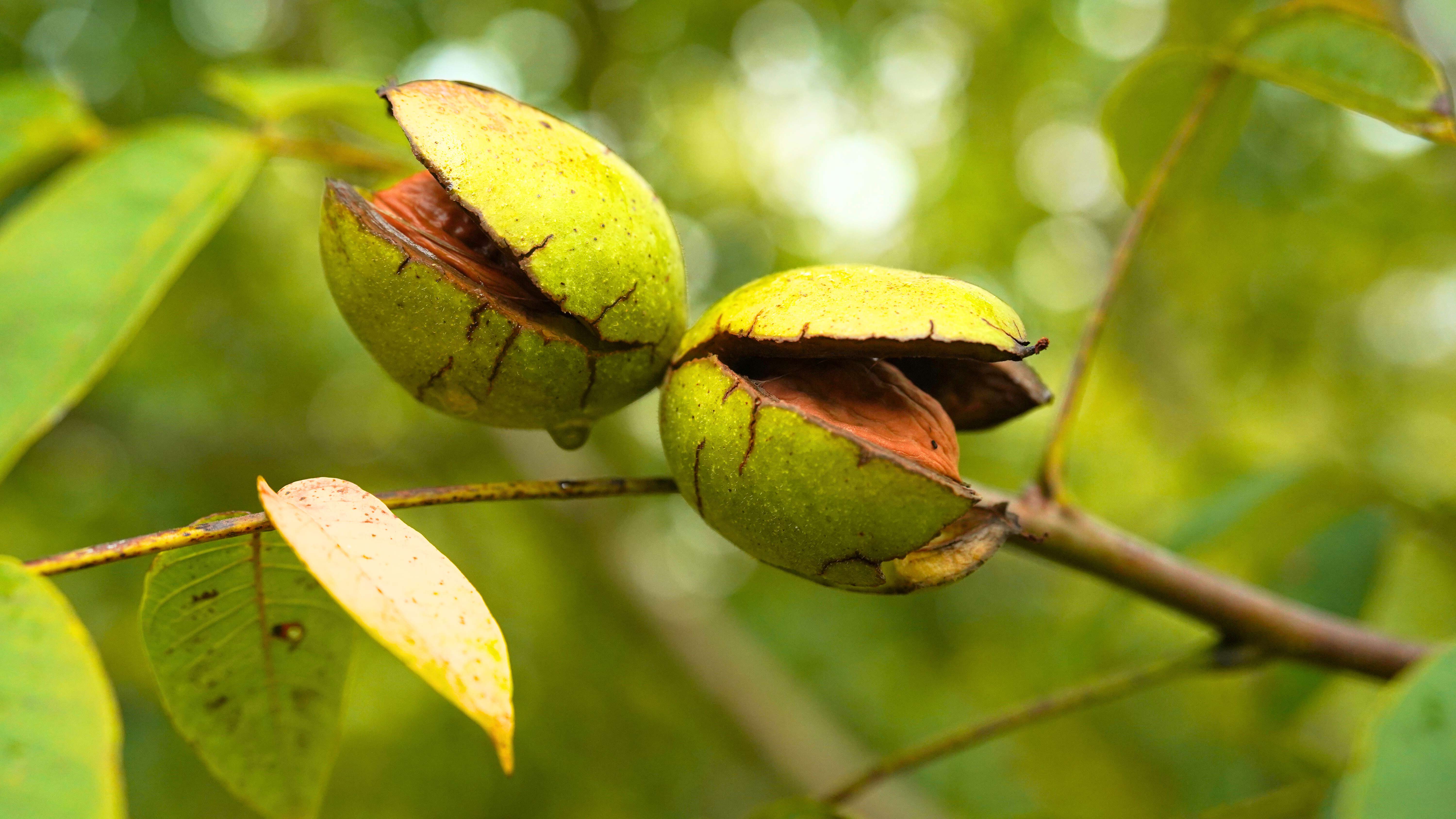
This is France's walnut heartland. The Correze and its neighbour the Dordogne produce a third of the nation's crop, and the trees are everywhere - in ordered orchards, along field boundaries, standing alone in farmyards. The Noix du Perigord holds AOP status since 2002, protecting four varieties: Franquette, Marbot, the horn-shaped Corne, and Grandjean.
Walnuts have shaped this landscape for centuries. In a region too far north for olives and too poor for butter, walnut oil was the cooking fat - the olive oil of the southwest. It lit church lamps when olive oil was too expensive to import. It fueled the calels (oil lamps) in farmhouse kitchens. Barrels of it travelled by river barge down the Dordogne to Bordeaux for export.
There was a tradition, in parts of the Perigord, of planting a walnut tree at a girl's birth. By the time she married, the tree would be bearing fruit - her dowry included its harvest.
Then came the freeze of February 1956. Temperatures plunged to -20C across the southwest. Entire orchards - trees that had stood for a century - were killed in a single night. An estimated 70 to 80 percent of walnut trees in the region were destroyed. The replanting took fifteen years, and the landscape was permanently changed: the hardy Franquette variety from the Dauphine replaced many of the traditional Perigord cultivars. Old-timers still have opinions about this.
First Glimpse of Turenne
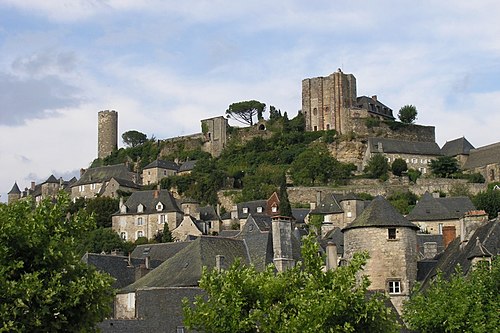
As the road curves southeast through the communes of Noailhac and Ligneyrac, something appears on the horizon - a hilltop silhouette, unmistakable even at a distance. Two towers on a rocky butte, commanding the valley. This is Turenne, and it will be the subject of the next segment, but even from here it demands attention.
The Viscounty of Turenne was one of the most powerful feudal territories in France. From the eleventh century until 1738, the viscounts controlled roughly 1,200 villages across the Correze, Lot, and Dordogne. They collected their own taxes, minted their own currency, maintained their own courts, and raised their own armies. The viscounty was a state within a state - exempt from royal authority by ancient privilege. It was only when the last viscount sold the territory to Louis XV for 4.2 million livres that it finally came under the French crown.
The most famous of the viscounts was Henri de La Tour d'Auvergne, Marshal of France, born in the castle in 1611. Napoleon studied his campaigns. The road our riders are descending was part of the territory he ruled.
The Geology Underfoot
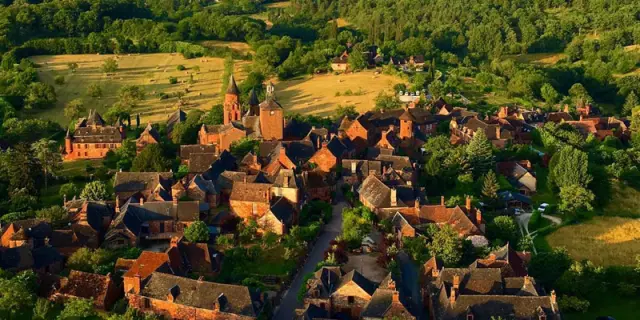
Something is changing in the stone. The Brive basin sits on Triassic and Permian sediments - sandstone and clay, deposited 250 million years ago. As the route heads south, the first hints of red begin to appear in farm walls and roadside outcrops. This is the iron-rich Permian sandstone that, a few kilometers further on, will colour an entire village the deep rust-red that made it famous.
The riders, at 70 km/h, will not notice the geology. But the geology is the reason Collonges-la-Rouge exists, and the reason this stretch of the Correze looks and feels different from the granite highlands to come.
From Famous Roads to Quiet Ones
Segment 1 was full of history - Koblet's breakaway, Cavendish's sprint, the Edmond Michelet museum. Segment 2 has none of this. No famous rider has ever attacked on this descent. No monument marks its verges. This is anonymous countryside, and that is precisely its character.
In a professional stage race, this is where the peloton sits up, drinks, eats, and reorganizes. The directeurs sportifs radio instructions from the team cars. The sprinters' teams begin to move toward the front. Nobody is racing yet - the real climbing starts after Beynat, forty kilometers and several hills from here.
For our four riders, the descent is a gift. The legs that were fresh at Malemort are still willing. The road falls away beneath them, and through the walnut trees, the towers of Turenne grow slowly larger against the southern sky.
Gallery
Drapeau Château de Turenne Corrèze
Photo by Selmoval · CC BY-SA 4.0 · Source
Viscounty of Turenne
Photo by Wikipedia · See Wikipedia article for license · Source
Château de Turenne
Photo by Wikipedia · See Wikipedia article for license · Source
Aubazines
Photo by Wikipedia · See Wikipedia article for license · Source
Nearby Attractions
Ruined hilltop keep of the Viscounty of Turenne. Controlled much of Correze until sold to Louis XV in 1738.
Tour de France History
Hugo Koblet's legendary 135km solo breakaway, holding off Coppi, Bobet, Bartali, Magni, Geminiani, and Robic. One of the greatest solo rides in Tour history.
Mark Cavendish sprint victory in the rainbow jersey of world champion. Bradley Wiggins in yellow on his way to becoming the first British Tour winner.
The Tour departed from Brive-la-Gaillarde heading to Villeneuve-sur-Lot.
Bernardo Ruiz of Spain won the Massif Central stage into Brive; Roger Leveque held yellow. The first half of the only year Brive hosted both a finish and the next day's start — the following morning, Brive launched Stage 11 to Agen, on which Hugo Koblet rode his legendary 135 km solo (see the 1951 Stage 11 entry above).
Edouard Sels of Belgium won the sprint into Brive; Jacques Anquetil in yellow. Brive was the launch pad for the next day's Stage 20 to the Puy-de-Dome — the day of the most-photographed duel in Tour history, Anquetil and Raymond Poulidor riding shoulder-to-shoulder up the volcanic plug.
Julio Jimenez of Spain won the mountaintop finish at the Puy-de-Dome; Anquetil held yellow to the line after the shoulder-to-shoulder duel with Poulidor on the volcanic plug. Anquetil lost seconds on the climb but kept the jersey by 14 seconds on the final podium — his fifth and last Tour win.
Barry Hoban of Great Britain won the sprint into Brive; Eddy Merckx in yellow on his way to the first of his five Tour wins. Hoban was Britain's most prolific Tour stage winner of the 1960s and 70s — eight career stages.
Pierre Matignon, the lanterne rouge of the race, attacked from a small group and held off the field for one of the most romantic stage wins in Tour history. Merckx held yellow. Brive was the launch pad for the underdog day.
Claude Tollet of France won the stage into Brive; Luis Ocana in yellow. The third Brive double-header in nine years — Ocana dominated the Massif Central transitions and won the next day's Stage 18 to the Puy-de-Dome, on his way to his only Tour victory.
Luis Ocana of Spain won the mountaintop finish at the Puy-de-Dome, dominating the Massif Central transition en route to his only Tour win. Brive was the launch pad.
Davis Phinney of the USA (7-Eleven) won the sprint — a rare American sprint win of the 1980s. Martial Gayant in yellow. The previous day, Stage 11 had finished at Chaumeil with Gayant's Systeme U teammate Charly Mottet losing the jersey on the same day Gayant inherited it (see seg 15). The corridor finished the day at Chaumeil, slept in Brive, and departed for Bordeaux.
Mario Cipollini of Italy won the sprint into Brive — his second consecutive stage win of the race. Stuart O'Grady in yellow. The first of three consecutive days the 1998 Tour spent in or around the Correze; the Festina doping scandal would break the next evening, on the eve of Stage 7.
Jacky Durand of France won from the breakaway as the Festina-less peloton left the corridor; Laurent Desbiens in yellow. The 1998 Tour had spent three full days in the Correze (Stage 6 finish at Brive, Stage 7 ITT around Tulle, Stage 8 departure from Brive) — the corridor was the geographic stage on which the Festina story broke (see seg 12-13 for Stage 7).
Serge Baguet of Belgium won the breakaway finish into Montlucon; Lance Armstrong in yellow (results subsequently annulled for doping). Brive's most recent Tour departure before 2012. The previous day's Stage 16 finish at Sarran — a presidential-courtesy stage town for then-sitting-President Jacques Chirac — was adjacent to the corridor (Sarran sits ~10 km north of seg 15).
Adjacent context — the start at La Riviere-de-Mansac sits in the Brive agglomeration ~15 km west of Brive, and the stage ran south-east toward Argentat well off the Stage 9 polyline. Jefferson Cepeda soloed in from 10 km out; Alex Baudin won the GC. The Tour du Limousin is the corridor's regular pro race — the resident that the 2026 Tour visits as guest.
Coming Up Next
Points available in the next segment:
Weather on April 8, 2026
Rider Standings
as of April 7, 2026
| Stat | Justin | Marian | Nan | Wally |
|---|---|---|---|---|
| Total (capped) | 14 km | 14 km | 14 km | 9.3 km |
| Daily avg (actual) | 4.57 km | 2.07 km | 3.53 km | 1.33 km |
| Daily avg (capped) | 2 km | 2 km | 2 km | 1.33 km |
| Longest day | 7.9 km | 3 km | 5 km | 2.5 km |
| Best 3-day | 15.6 km | 7 km | 11.9 km | 5 km |
| Recent 5-day avg | 3.97 km | 2.2 km | 3.88 km | 1.28 km |
| Days <3km | 3 | 6 | 2 | 7 |
| Sprint pts | 3 | 2 | 5 | 1 |
| Climb pts | 2 | 0 | 1 | 0 |
| Remaining | 171 km | 171 km | 171 km | 175.7 km |
| Est. finish | Jul3 | Jul3 | Jul3 | Aug19 |